Executive summary: the reported $6.43 billion heist
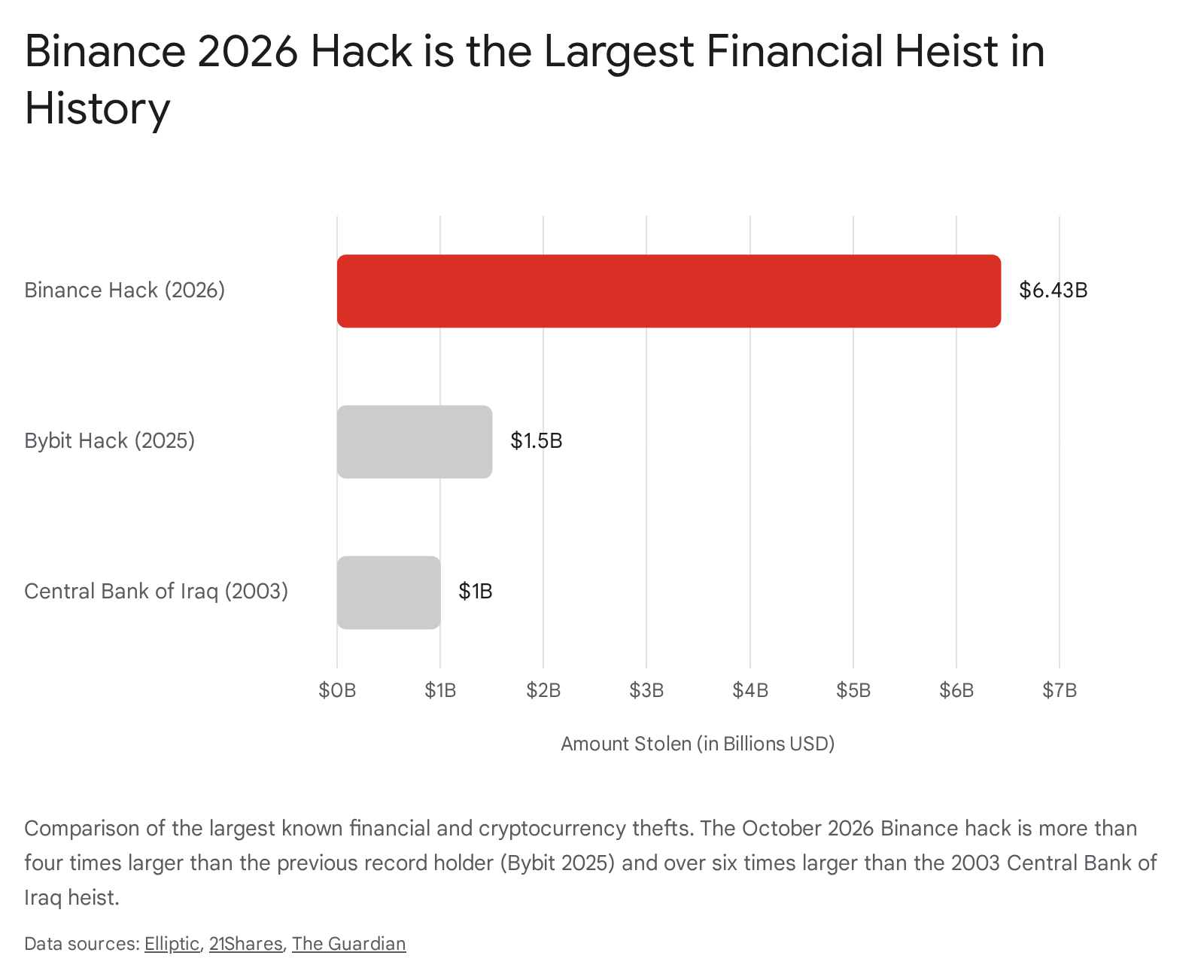
The supplied analysis states that on October 29, 2026, Binance experienced a major security incident involving its active hot wallets. It estimates the value of assets removed during an attack window of about 31 minutes at between $6.3 billion and $6.43 billion. These numbers are claims in the supplied report, not an independent determination by ReturnMadeEasy.
If confirmed, the event would rank among the largest reported digital-asset thefts. The analysis compares it with the reported 2025 Bybit theft and the 2003 Central Bank of Iraq robbery. It also says that activity touched eleven blockchain networks and that the attackers targeted operational workflows rather than breaking the underlying cryptography of those networks.
The report further claims that stablecoin issuers and network security bodies froze approximately $2.84 billion to $3 billion, while native assets such as Bitcoin and Ether were more difficult to immobilize. Attribution in the supplied material points to the North Korea-linked TraderTraitor operation, but attribution should be treated as an investigative conclusion subject to evidence and official confirmation.
The reported attack vector: operational compromise
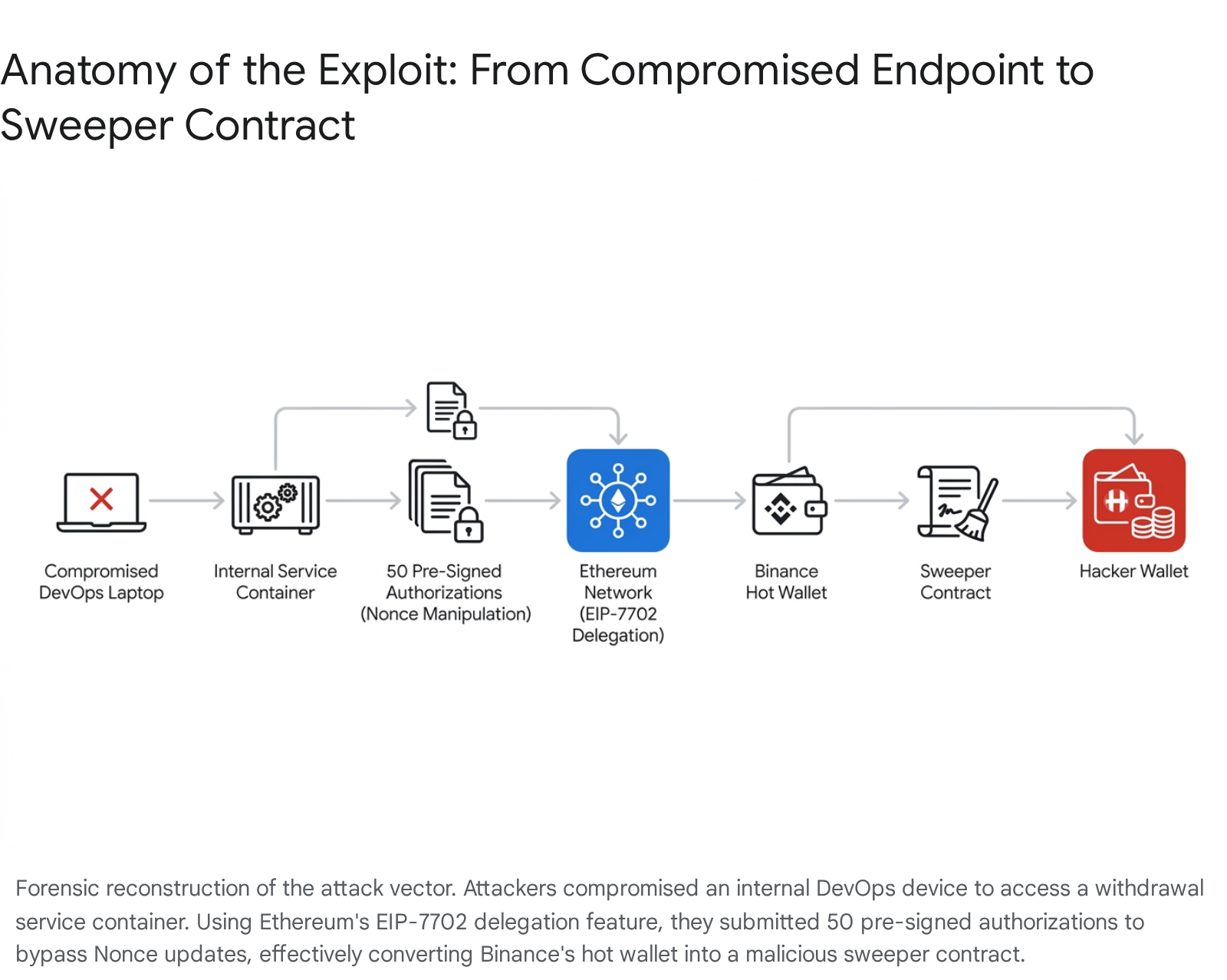
According to the supplied account, the attackers did not need to steal a static private key. Instead, they allegedly compromised an internal DevOps endpoint and reached a service container involved in withdrawal authorization. A trusted signing system then produced technically valid transactions in response to unauthorized instructions.
This distinction matters for exchange security. Strong cryptography can protect a key while an organization remains vulnerable to compromised endpoints, excessive permissions, weak workflow verification, or insufficient separation between deployment systems and transaction approval systems.
Pre-attack reconnaissance and the Ethereum exploit
The supplied material describes advance preparation, including small funding transfers, smart-contract tests, and a rehearsal before the alleged theft. It says the Ethereum portion involved EIP-7702, a feature designed to allow an externally owned account to delegate transaction logic to a contract.
The report alleges that a malicious sweeper contract was paired with a burst of 50 pre-signed authorizations to account for changing transaction nonces. It claims that one authorization matched the active nonce, enabling a sweep of assets from a Binance Ethereum hot wallet. These technical details should be validated against the relevant transaction hashes and official incident reports.
Cross-chain synchronization and the 31-minute drain
The analysis says that withdrawals were coordinated across XRP Ledger, Solana, Bitcoin, Tron, Base, Optimism, Arbitrum, NEAR, Polygon, Avalanche, and Ethereum. It presents the following reported sequence: XRP transfers shortly after 20:05 UTC, alternative-network withdrawals around 20:10, the Ethereum authorization burst around 20:20, Bitcoin outflows around 20:20, and further network activity later in the evening.
Moving value across networks with different signing models would require access to shared exchange infrastructure or a highly coordinated set of compromises. That is why cross-chain timing, transaction hashes, wallet attribution, and exchange disclosures are central to any reliable forensic review.

Asset tracing, laundering, and recovery claims
The supplied article estimates the stolen portfolio included Ethereum-based tokens, Bitcoin, Tron-based USDT, XRP, Solana, and assets on several layer-one and layer-two networks. It describes rapid swaps from potentially freezeable stablecoins into native assets, DeFi collateralization, and Bitcoin peel chains as alleged methods for complicating recovery.
It also claims that Tether, Circle, Ripple, and certain network bodies froze or secured a substantial portion of the reported value. The recovery chart below is included as an illustration of the supplied figures, not as an independently audited balance.
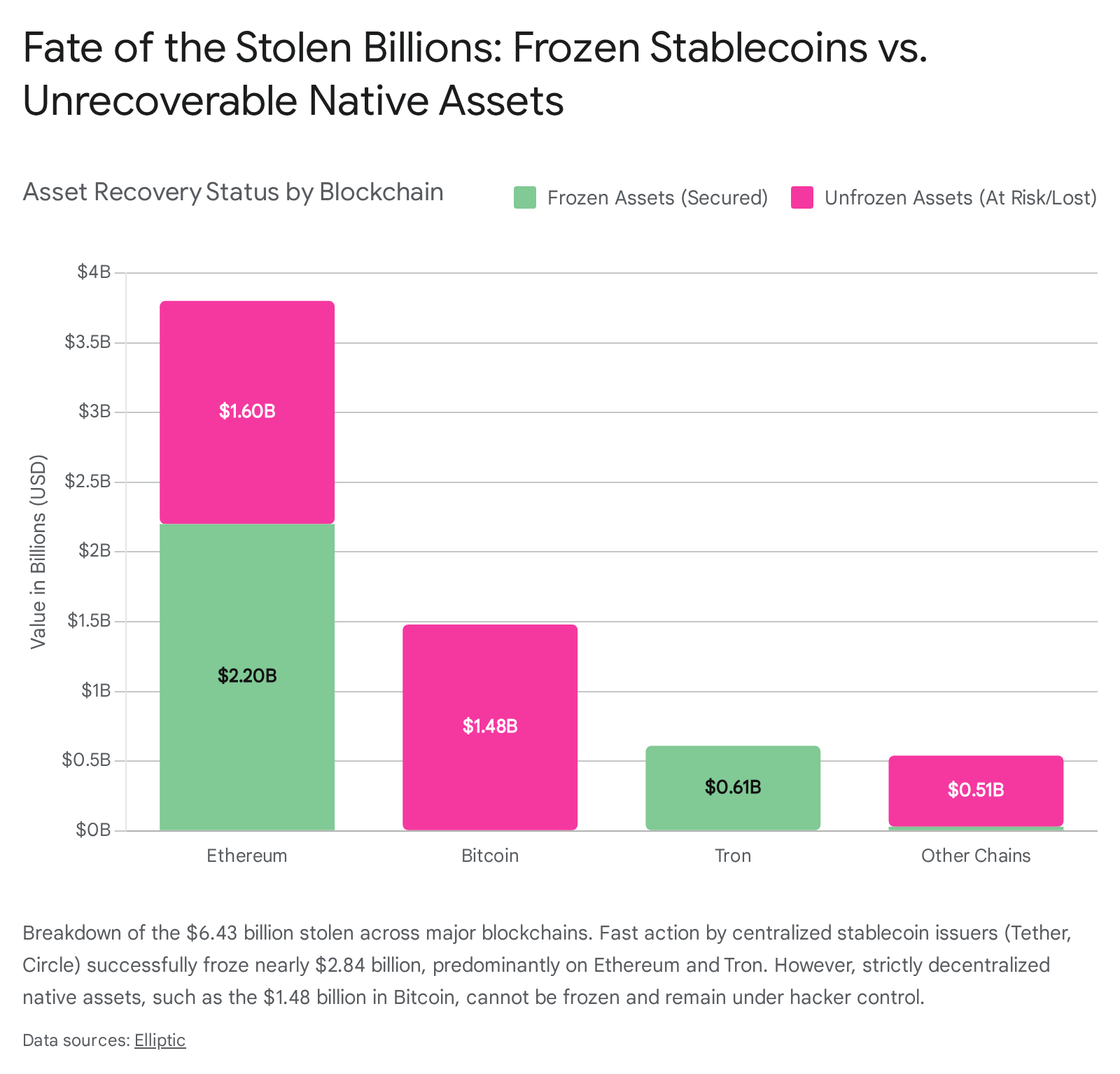
The incident highlights a centralization paradox: centralized stablecoins can sometimes be frozen by their issuers, while native assets generally cannot be reversed by a central administrator. That difference can improve recovery in one part of a portfolio while raising questions about censorship resistance and issuer power.
Attribution and geopolitical implications
The supplied sources attribute the alleged breach to TraderTraitor, described as a North Korea-linked operation within the broader Lazarus Group. The report cites wallet behavior, infrastructure links, laundering patterns, and similarities to previous incidents. Attribution of sophisticated cybercrime is rarely established by one signal, so readers should distinguish between reported assessments, official findings, and proven on-chain evidence.
Market impact and reported liquidations
The supplied material says Bitcoin declined about 3.2 percent, BNB fell roughly 7 percent, and 24-hour leveraged liquidations reached approximately $1.57 billion around the event. It also describes short-term pressure on crypto-related equities. These figures are time-sensitive market data and should be checked against historical price feeds and liquidation dashboards.
| Metric | Reported impact | Verification note |
|---|---|---|
| Bitcoin | About 3.2% decline | Check historical market data |
| BNB | About 7% decline | Check exchange and market feeds |
| 24-hour liquidations | About $1.57 billion | Check CoinGlass or equivalent records |
Solvency, user protection, and operational recovery
The supplied account says Binance committed to covering user losses and discussed its SAFU reserve, recovered assets, corporate treasury, and other liquidity resources. It also claims that withdrawals were temporarily suspended while security teams investigated and that the exchange planned a technical post-mortem and a refreshed proof-of-reserves report.
Proof of reserves can help show whether identified assets exist, but it does not by itself prove complete solvency, control of every liability, or the absence of operational compromise. Users should rely on official notices and avoid making decisions based only on social-media claims.
Security lessons for exchanges and users
- Separate deployment credentials from withdrawal authorization systems.
- Use least-privilege access, hardware-backed approvals, and independent transaction-intent checks.
- Apply velocity limits, anomaly detection, and multi-person review to unusual cross-chain withdrawals.
- Monitor delegation features and smart-contract permissions as carefully as private keys.
- Publish verifiable incident timelines, transaction hashes, and recovery updates.
Sources and further reading
The supplied article listed the following outlets and research organizations. Links are provided by domain so readers can locate the original reporting and compare updates:
- elliptic.co
- trmlabs.com
- beincrypto.com
- 21shares.com
- theguardian.com
- blockaid.io
- chainalysis.com
- securityboulevard.com
- binance.com
- decrypt.co
- washingtonpost.com
- theblock.co
- thehackernews.com
- tradingview.com
This article is informational and is not financial, legal, or cybersecurity advice. Cryptocurrency markets are volatile, and incident reporting can change as investigations continue.